Empowering Justice Through Integrity and Innovation.
Accelerating access to justice with advanced audio capture, real-time speech-to-text, secure cloud-based storage, and instant access to records.


Exceeding Industry Standards for Security
Audited and certified to meet the highest global security and privacy benchmarks.








Protection
Management

30+
Years pioneering justice technology
98%
Speech-to-text accuracy with FTR RealTime
80+
Supporting courts in more than 80 countries around the world
Your Hub for Insights & Information.
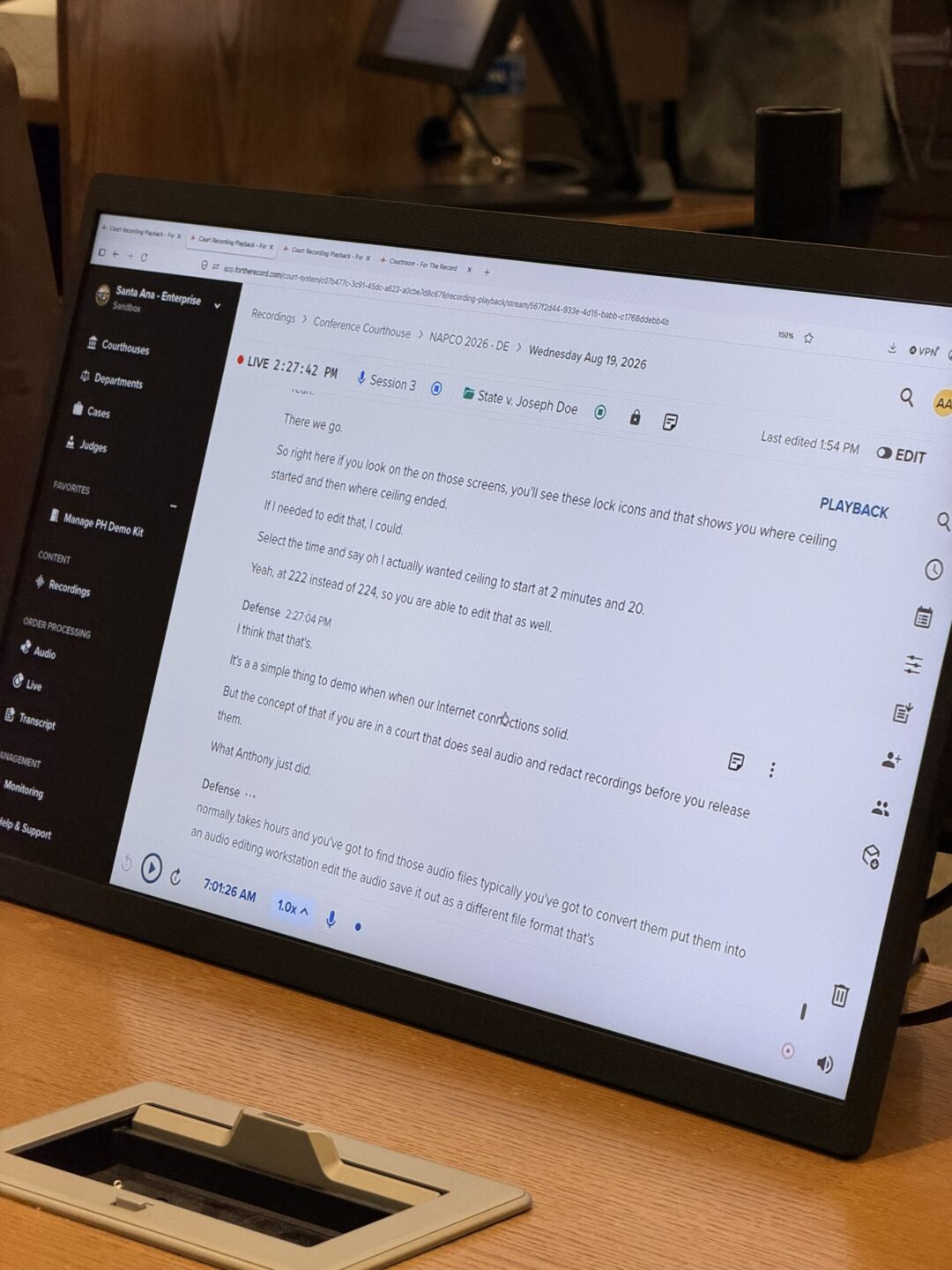



Modernizing Court Records
The court record is more than transcripts—it’s the foundation of justice, accountability, and transparency.
A court record is the official, permanent account of a legal case. It captures testimony, filed documents, evidence, and final outcomes, serving as the authoritative history of proceedings for legal, historical, and public review.
Today, the modern court record extends beyond transcripts—bringing together multi-channel audio and video recordings, speech-to-text transcripts, certified transcripts, notes, filed documents, evidence, and exhibits into a comprehensive and reliable source of truth. Without a reliable record, appeals cannot be properly considered and confidence in the justice system is at risk.
- Protects the integrity of legal proceedings
- Ensures decisions can be reviewed and rights upheld
- Provides transparency and public accountability
- Enhances legal research to guide strategy
- Supports parity in judicial sentencing and outcomes
- Captures and manages official court content, including audio/video recordings and speech-to-text transcripts
- Secures recordings and other sensitive court data with built-in redundancy
- Supports real-time transcription
- Enables more streamlined workflows and operational efficiency
- Ensures courts retain control while authorized participants have secure access
- Provides accessible technology to facilitate ADA-compliant courtrooms
- Stenographer shortages mean many proceedings are not captured—raising access to justice and constitutional concerns
- When courts cannot or do not provide a stenographer, hiring a private stenographer becomes a litigant expense that few can afford
- Transcript-only court records might be owned by individual stenographers, posing access issues
- Without a recording, transcript-only court records are not verifiable
- Modern courts need searchable, connected, and securely stored court records
- Moves from isolated files to a unified digital record
- Connects audio, transcripts, notes, documents, evidence, and exhibits
- Makes records easier to search, review, and trust
Modernizing court records ensures long-term reliability and accessibility, allowing courts to maintain ownership and confidence in the official record—today and in the future.