


For decades, court records have evolved alongside technology. As the primary method of creating the official record, court recording has progressed from paper transcripts to digital audio, giving courts faster access to proceedings and a more complete, reliable account of what occurred. Today, courts are rethinking not just how the record is captured, but how it is managed, accessed, and used.
In recent decades, court recording has primarily been focused on one essential task: capturing an accurate record of proceedings. Once recorded, those files were stored and retrieved when needed.
Today, courts expect much more. As they face growing caseloads, increasing accessibility requirements, staffing shortages, and heightened cybersecurity expectations, managing the official record has become just as important as capturing it. Rather than treating recordings as isolated audio files, modern record management connects proceedings throughout the lifecycle of a case, making it easy to locate, search, review, and access the complete case record from a single place. The official record has become a critical source of information that must be searchable, secure, accessible, and easy to manage.
As courts modernize, balancing innovation with the security, integrity, and accessibility of the official record is more important than ever. Technologies such as cloud storage, speech-to-text, and artificial intelligence are creating new opportunities to improve court operations, but they also raise important questions about governance, compliance, and trust.
At NACM 2026, our team explored how modern court recording is evolving beyond capture alone to help courts build more resilient workflows around the official record—improving access to justice while preserving the integrity of judicial proceedings.
One of the biggest opportunities for modernization is improving access to proceedings—not just after a hearing, but while it is in session.
Recent updates to ADA Title II have placed greater emphasis on ensuring digital services and communications are accessible, reinforcing the need for courts to provide effective accommodations for individuals with disabilities. While compliance involves a range of policies, processes, and technologies, real-time speech-to-text can play an important role in helping courts meet these evolving accessibility expectations.
Real-time speech-to-text can provide live captions throughout a proceeding, allowing courts to instantly accommodate participants who are deaf or hard of hearing without requiring advance notice or delaying proceedings. Displaying captions on courtroom monitors, tablets, or other courtroom displays helps ensure everyone can follow what is being said while supporting broader accessibility initiatives.
As Steve Zinone, Senior Director – Justice Solutions, explained during the session, courts often don’t know an accommodation is needed until someone arrives for their hearing.
“With live captions available on courtroom displays or tablets, staff can provide that accommodation immediately. There’s no need to call a recess or ask someone to return another day—they can participate in the proceeding straight away.”
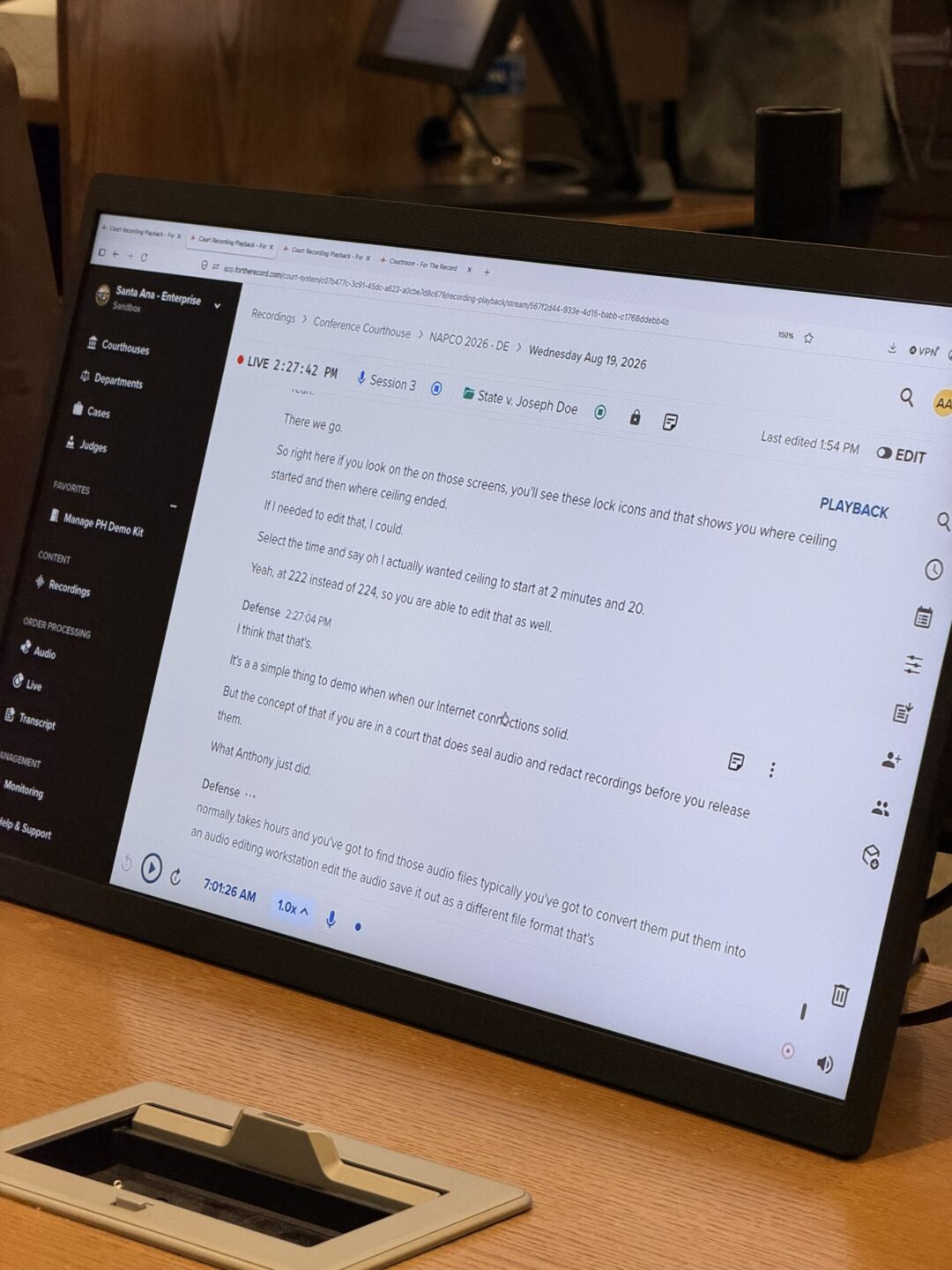
Beyond accessibility, synchronized speech-to-text also makes reviewing proceedings significantly faster. Instead of manually listening through lengthy recordings, court staff can search, navigate, and replay specific portions of a hearing within seconds.
Importantly, these capabilities enhance—rather than replace—the official record. The synchronized transcript provides another way to interact with proceedings, while the original audio remains the authoritative record of what occurred in court.

Providing attorneys, litigants, appellate courts, and other authorized users with access to recordings has traditionally involved copying files, transferring media, or managing multiple versions of the record.
Modern cloud platforms offer a different approach.
Instead of distributing recording files, courts can securely share access through permission-based links. Courts retain control over who can view a recording, revoke access at any time, and maintain a comprehensive audit trail showing who accessed the record, when, and which portions were viewed.
As Anthony Agnello, Vice President – Justice Solutions Sales, demonstrated, modern sharing is about maintaining control and visibility rather than simply transferring files.
“You have full control over who’s able to access the content, and you have a complete audit trail of who has accessed the record.”
This creates a more transparent and secure process while reducing administrative effort and helping preserve the chain of custody throughout the lifecycle of the official record.
As courts increasingly move critical systems to the cloud, protecting judicial records remains one of the highest priorities.
Modern recording platforms incorporate encryption in transit and at rest, role-based permissions, detailed audit logging, tamper detection, and comprehensive activity tracking. Together, these capabilities help courts demonstrate that the official record has remained secure and unchanged.
For Tony Douglass, Chief Executive Officer, maintaining the integrity of the original record remains the foundation of every technological advancement.
“The audio is the only piece of the record that I know is 100% accurate.”
That philosophy becomes increasingly important as courts begin evaluating AI-enabled technologies.
Artificial intelligence can improve search, organization, accessibility, and workflow automation, but it should never compromise confidence in the official record. Courts need assurance that recordings remain under their control and that sensitive judicial data is not used to train third-party AI models without authorization.
Steve Zinone believes those questions should be part of every technology evaluation.
“A very important question to ask any vendor is: Is my content secure, and are you allowing a third party to use that content to train their large language models?”
Responsible modernization requires innovation to be supported by strong governance, transparent security practices, and clear ownership of court data.
Court records frequently contain confidential or sensitive information that must be protected.
Historically, protecting sensitive portions of a proceeding often meant creating multiple versions of a recording or manually managing redacted copies.
Modern systems can take a different approach by applying permissions directly to the official record itself.
Rather than creating duplicate files, authorized users can seal specific sections while maintaining a single authoritative recording. Different users see only the information they are permitted to access, reducing administrative complexity while preserving the integrity of the original record.
As Tony Douglass explained during the demonstration:
“You don’t have to create a new file. You don’t have to manage a new file. You’re changing permissions—not the actual recording.”
Combined with detailed audit trails and role-based permissions, this approach helps courts balance transparency with the responsibility to protect confidential information.
Many courts continue to face challenges recruiting and retaining court reporters and transcription professionals while simultaneously responding to increasing demands for faster access to court records.
Technology is not intended to replace certified transcripts where they are required. Instead, speech-to-text and digital workflows provide additional tools that help courts improve efficiency, support transcript production, and expand access to proceedings.
As Steve Zinone noted, the role of these technologies ultimately depends on each jurisdiction’s rules and procedures.
“Whether speech-to-text becomes part of the official transcript depends on the court’s rules and regulations. Today, it’s a tool that helps the judiciary, court operations, and litigants work more efficiently.”
Some courts are already demonstrating how these tools can support established judicial workflows. During the NACM session, Tim Jackson, Senior Director – Customer Success at For The Record, highlighted an example from the New Mexico Court of Appeals, where judges are provided with secure access to synchronized audio recordings and speech-to-text when cases are appealed, rather than relying solely on certified transcripts.
While Tim noted this is a relatively unique implementation, it illustrates how jurisdictions are beginning to leverage digital records in ways that improve access to proceedings while maintaining confidence in the official record. Rather than replacing existing processes, these technologies provide additional ways for judges and court staff to review proceedings efficiently and make informed decisions.
As more courts evaluate digital modernization, examples like New Mexico demonstrate that speech-to-text can complement traditional court reporting practices while expanding how the official record is accessed and used.
Perhaps the most important lesson in court modernization is that there is no one-size-fits-all approach.
Every jurisdiction has different rules, retention requirements, security policies, and operational processes. Successful implementations begin by understanding how a court currently manages the official record before configuring technology to support those workflows—not the other way around.
Tim Jackson, Senior Director – Customer Success, emphasized that modernization should begin with understanding each court’s unique requirements.
“Every court is unique. We sit down with each court to understand what they’re trying to achieve, how they work today, and how technology can adapt to support or improve those existing processes.”
That collaborative approach helps ensure technology strengthens existing operations rather than forcing courts to redesign well-established judicial processes.
Modern court recording is no longer just about capturing proceedings.
It is about creating a trusted digital record that is searchable, secure, accessible, and adaptable to the evolving needs of courts and the communities they serve.
As courts continue their digital transformation journeys, the challenge is no longer whether to modernize the official record. It is how to embrace new technologies while preserving the principles that define the justice system: accuracy, transparency, accessibility, security, and trust.
The most resilient courts won’t simply adopt new technology. They’ll build a trusted digital foundation that allows innovation to strengthen—not compromise—the integrity of the official record.