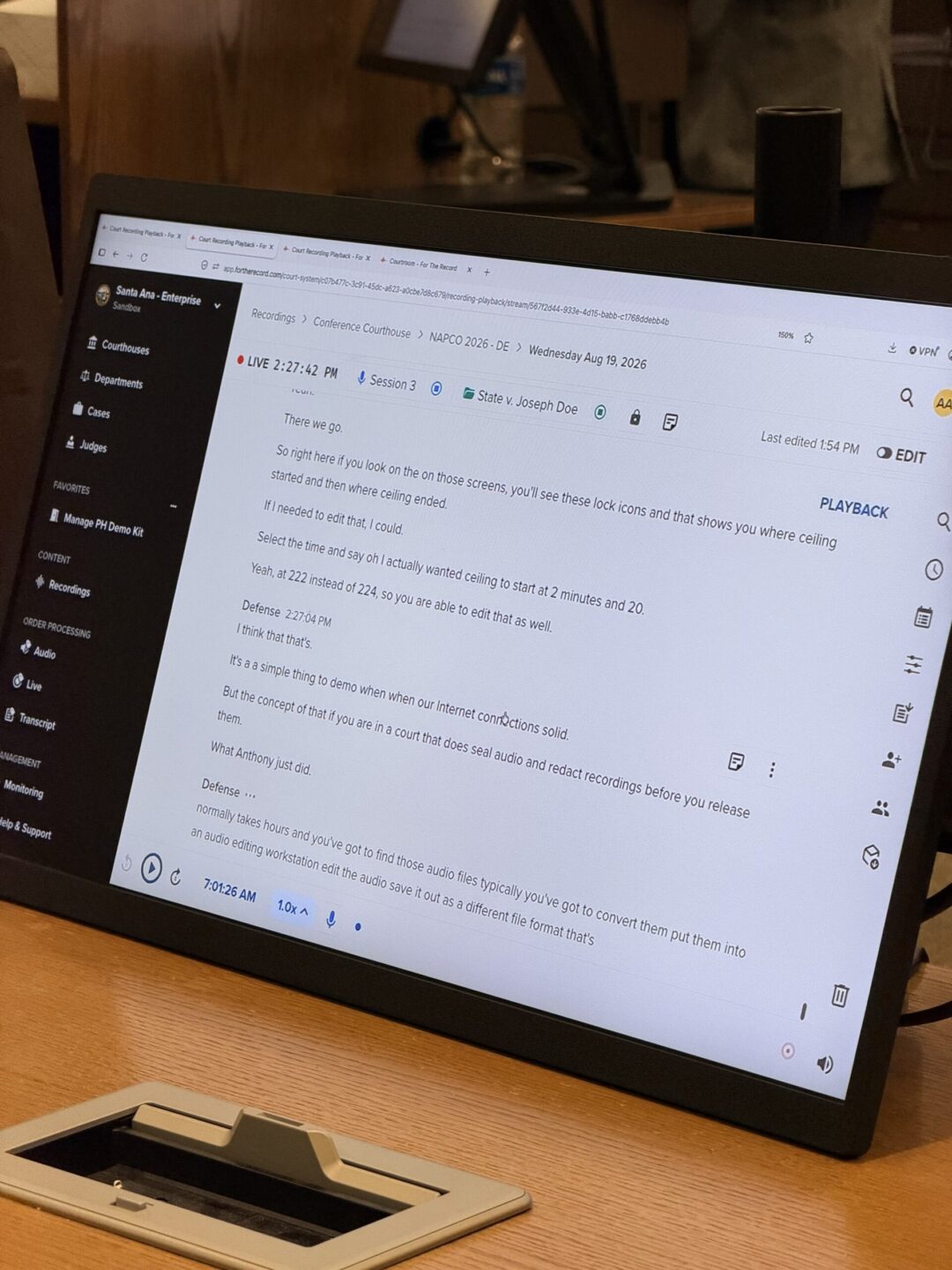



For The Record follows a continuous innovation model supported by dedicated product, design, development, quality assurance, and customer success teams focused exclusively on the needs of courts and justice organizations.
Rather than waiting for large-scale software releases, we deliver incremental improvements after extensive testing, allowing courts to benefit from new capabilities, usability enhancements, performance improvements, and security updates without waiting for major upgrade cycles. This ensures innovation is delivered continuously throughout the year, helping courts realize value sooner while avoiding disruptive technology replacement projects.
The FTR Justice Cloud roadmap is shaped through ongoing collaboration with courts, justice agencies, and daily platform users. Product and customer success teams work closely with stakeholders to understand operational challenges, identify opportunities for improvement, and gather feedback on existing workflows.
This insight is strengthened by ongoing discovery and research conducted by our design and product teams, including user interviews, workflow analysis, usability testing, customer surveys, industry research, and evaluation of emerging technologies. These activities ensure development is focused on solving real-world challenges and delivering measurable value to court users.
By combining customer feedback, operational insight, and industry research, we prioritise initiatives that balance immediate needs with long-term innovation and modernization goals.
Continuous innovation requires a disciplined process that extends beyond software development. Every enhancement follows a structured lifecycle that includes discovery, planning, design, implementation, quality assurance, release management, change management, and post-release monitoring.
Product, design, and engineering teams work collaboratively throughout each stage to ensure new capabilities are practical, intuitive, secure, and aligned with customer needs. Concepts are validated early, helping ensure development effort is focused on initiatives that deliver meaningful impact.
Once implemented, enhancements undergo rigorous automated and manual testing across functional, performance, usability, accessibility, and security requirements, ensuring reliability and stability in production environments.
FTR Justice Cloud is supported by modern development, deployment, and monitoring practices that enable frequent, low-disruption delivery of improvements in high-trust justice environments. Rather than grouping changes into large releases, enhancements are deployed incrementally as they are validated and ready for use.
Automated testing, continuous integration, operational monitoring, and structured release management ensure new functionality is introduced safely and predictably. Post-release monitoring enables teams to quickly detect, investigate, and resolve issues, maintaining platform stability and performance.
Security is embedded throughout the development lifecycle, ensuring compliance, resilience, and protection of sensitive court information as standard rather than as a separate process.
FTR Justice Cloud’s security and operational practices align with SOC 2 Type II, NIST 800-53 Revision 5, CJIS requirements, and UK Cyber Essentials, supporting a disciplined approach to risk management, compliance, and security assurance.
This continuous cycle of feedback, research, design, development, testing, deployment, and monitoring ensures innovation is embedded into the platform itself. As court requirements evolve, FTR Justice Cloud evolves alongside them—supporting new workflows, improving accessibility, incorporating emerging technologies, and enabling broader digital transformation initiatives.
FTR Justice Cloud is more than a recording solution. It is an actively developed court technology platform that captures, manages, secures, enhances, and provides access to the official court record.
Through integrated real-time speech-to-text, intelligent case and participant annotations, AI-powered hearing summaries, centralized administration, secure cloud storage, and browser-based access from any authorized device, the platform transforms courtroom data into actionable information.
By bringing these capabilities together within a single end-to-end ecosystem, courts gain more than a recording system. They gain a continuously evolving platform backed by dedicated product, design, engineering, security, and customer success teams focused on delivering ongoing innovation, maintaining security and reliability, and helping courts modernize with confidence.