
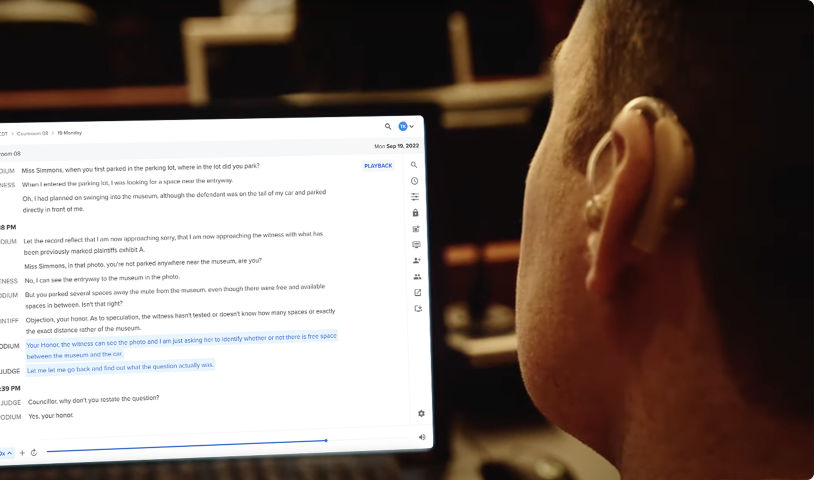
Inclusive, equitable access should be seamless. With FTR RealTime, accessibility is built in—supporting equal participation for people of all backgrounds, languages, and abilities, and helping your team meet ADA Title II requirements.
Whether someone is hard of hearing, processes information better in written form, or speaks English as a second language, FTR RealTime offers a new kind of access: a live, speech-to-text feed of courtroom proceedings, just seconds behind the spoken word. This powerful assistive technology is a direct response to the ongoing efforts of the disability rights movement to ensure equal access to justice for all.
Contact UsJustice, made accessible, with live speech-to-text.
That’s the power of universal design—removing barriers before they arise. This technology expands access for individuals who have historically faced challenges in courtroom participation, helping to bridge the digital divide and knowledge gap.
Justice isn’t truly served until it’s accessible to all. Schedule a demo today!
Request a Demo Talk to an ExpertAt For The Record, we believe that accessibility shouldn’t be an afterthought—it should be embedded in the experience from the start. Our commitment to inclusivity is inspired by the work of organizations like the W3C’s Web Accessibility Initiative and the United Nations, which champion accessibility as a fundamental human right.
That’s why we design our products and platforms with inclusivity at their core and continue to incorporate user feedback to ensure maximum functionality.
The FTR Justice Cloud platform adheres to WCAG 2.2.
For those who depend on an interpreter, FTR RealTime adds a layer of transparency. It allows participants—and their legal teams—to see what was said in English, alongside the interpreted translation. If something gets lost, mistranslated, or misheard, it’s visible and part of the record.
With FTR RealTime, participants can confirm the accuracy of interpreted statements and catch moments where miscommunication might alter outcomes. Our solution reduces reliance on secondhand summaries and helps people feel seen and included.
Tools like FTR RealTime help reduce the sense of isolation that people with disabilities can experience. They normalize the use of assistive technologies in everyday environments and reinforce the idea that accessibility improves the experience for everyone.
As with the ongoing shortage of stenographers, there’s also a growing shortage of professionals providing Communication Access Realtime Translation (CART) services—specialists who convert spoken language into written text in real time. Technologies like FTR RealTime can help bridge that gap by expanding access to real-time transcription and captioning in settings where human CART providers may not be available.
While some participants may still require specific accommodations—such as sign language interpreters, hearing aids, or screen readers—it’s important to acknowledge the increasing difficulty in procuring qualified interpreters or CART services. In these cases, FTR RealTime provides an additional layer of accessibility, offering a shared, immediate source of information that benefits many participants.
FTR RealTime supports people who:
Participation isn’t just about being present—it’s about being empowered to understand and respond.
FTR RealTime transforms accessibility from an accommodation into a standard.
FTR RealTime supports equal participation for people of all backgrounds, languages, and abilities.
By turning the spoken word into a searchable, written record, FTR RealTime empowers every courtroom participant to engage fully, confidently, and with dignity. As strong advocates for access to justice, For The Record consistently enhances our solutions to support courts in empowering participants in the justice system.
Discover how FTR RealTime can help you achieve your ADA court compliance goals and foster a more inclusive and equitable justice system for all.
Talk to an Expert